


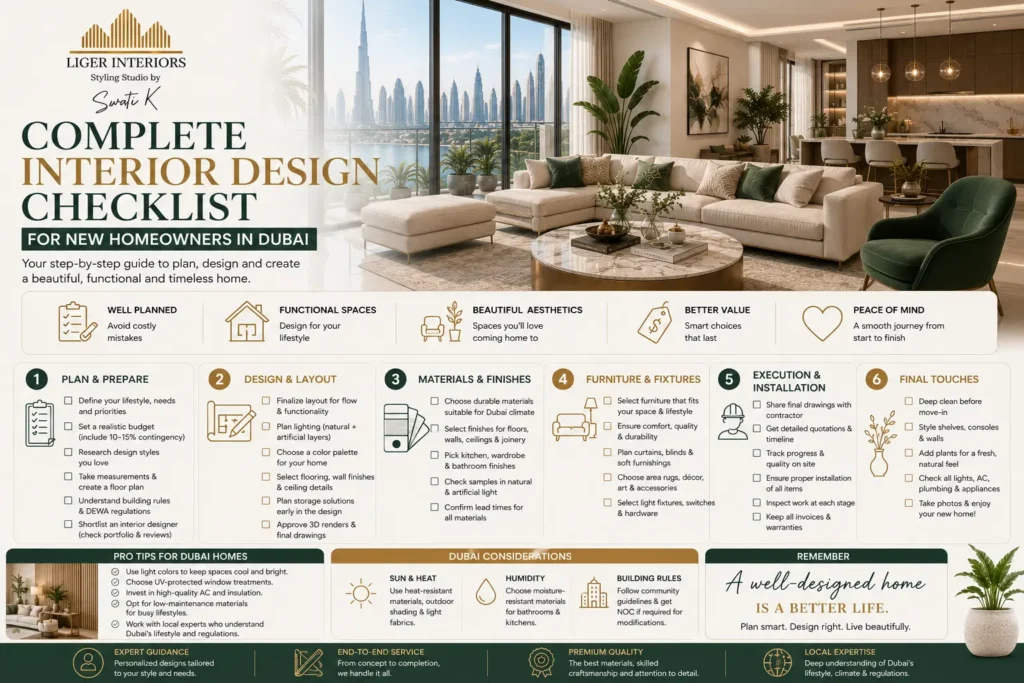
Complete Interior Design Checklist for New Homeowners in Dubai
You just got the keys to a new apartment or villa in Dubai. The space is bare, or close to it. Developer-standard finishes, maybe some basic kitchen cabinetry, white walls throughout.
Now you need to turn it into a home, and the number of decisions ahead can feel overwhelming. Where do you start? What comes first? What can wait?
This checklist walks you through every step, room by room, so nothing gets missed and your money goes where it counts.
Before You Start: The Planning Decisions
Set Your Total Budget
Write down the maximum amount you can spend. Not what you hope to spend. The maximum. Then work backwards from there.
A rough split for a full interior fitout:
Flooring: 15 to 20 percent of budget. Kitchen (if upgrading from developer standard): 15 to 25 percent. Bathrooms (if upgrading): 10 to 15 percent. Joinery (wardrobes, TV units, storage): 10 to 15 percent. Furniture and soft furnishings: 15 to 25 percent. Lighting: 5 to 10 percent. Painting and walls: 5 to 10 percent. Contingency: 10 to 15 percent.
If your total budget is AED 200,000, that gives you a rough idea of what each category gets. Adjust based on your priorities.
For detailed pricing, see our interior design cost guide.
Decide What to Keep and What to Change
Developer kitchens and bathrooms in Dubai are functional but generic. Before you rip them out, ask whether they are genuinely bad or just not to your taste. A kitchen that works fine structurally might only need new countertops, handles, and a splashback instead of a full replacement. That saves AED 50,000 or more.
The same applies to flooring. Developer tiles are often decent quality porcelain. If the colour works with your plan, save the demolition cost and spend that money on furniture and lighting instead.
Pick Your Style Direction
Before you buy a single piece of furniture, pick a general direction. You do not need a mood board with 47 Pinterest images. You need to answer one question: what feeling do you want when you walk in?
Warm and natural? Sleek and minimal? Bold and colourful? Traditional with modern touches?
Having a clear direction prevents the common mistake of buying beautiful individual pieces that look terrible together because they belong to different design worlds.
If you need help figuring out your direction, that is what a design consultation is for. We spend the first session understanding how you live and what you respond to, before we design anything.
Room-by-Room Checklist
Living Room
Flooring: Upgrade from developer tiles if needed (SPC, porcelain, or marble). See our flooring guide. Paint: Choose a colour that works with your furniture plan. Test samples on the wall in daylight and at night. Feature wall: A textured or accent wall behind the TV or sofa. This is our specialty at Liger Interiors. One feature wall can define the whole room. Lighting: Mix of downlights, a pendant or chandelier, and accent lighting (cove lights in false ceiling, picture lights, floor lamp). Sofa: The biggest purchase. Measure your space and doorways before ordering. TV unit: Built-in looks cleaner than freestanding. Include cable management. Curtains: Floor-length, lined, on a motorised or manual track. Sheer layer for daytime privacy. Rug: Defines the seating area. Choose a size that fits under the front legs of the sofa at minimum.
Kitchen
Assess developer kitchen first. If layout works, consider resurfacing instead of replacing. Countertops: Quartz or sintered stone. More durable than marble for daily use. Splashback: Porcelain tile, glass, or the same stone as the countertop. Handles: New handles on existing cabinets can change the whole look for AED 500 to 2,000. Lighting: Under-cabinet LED strips for task lighting. Pendant over an island if you have one. Appliances: Built-in looks cleaner. Confirm electrical capacity for double ovens or induction hobs before ordering.
Bedrooms
Paint: Warm, calming tones. Avoid anything too stimulating for a room meant for sleep. Wardrobes: Built-in wardrobes with proper internal layout (hanging, shelves, drawers, shoe section). If your villa has no wardrobes, this is the single most important joinery investment. Bed: Good mattress is more important than the bed frame. Budget accordingly. Bedside tables with lamps. USB charging built into the sockets if you are doing electrical work. Blackout curtains: Essential in Dubai. Morning sun wakes you at 5am without them. Flooring: SPC or engineered wood for a warm feel. Or keep developer tiles and add a large area rug.
Bathrooms
Check developer waterproofing. If the bathroom was done properly at handover, you may not need a full renovation. Accessories: Towel rails, robe hooks, toilet roll holder, soap dispensers. Match the finish (chrome, matte black, or brushed gold). Mirror: An upgrade from the builder-grade mirror to a backlit LED mirror makes a big difference. Storage: If the vanity has no storage, add a mirrored cabinet above. Bath mat, quality towels, and a shower caddy.
Entrance / Hallway
Console table or narrow storage unit. Mirror to make the space feel bigger. A rug or mat for sand and shoes. Lighting: A pendant or flush-mount ceiling light. Developer spotlights in hallways are usually too harsh.
Balcony / Terrace
Outdoor furniture (weather-rated for Dubai sun). Plants (heat-tolerant varieties with drip irrigation). Shade: Umbrella, awning, or shade sail. Outdoor rug (optional, synthetic material that drains water).
What to Do First, Second, Third
Order matters. You cannot hang curtains before painting, and you should not pick furniture before flooring.
Phase 1: Construction work. Flooring, painting, false ceilings, electrical changes, kitchen upgrades, bathroom upgrades. If you are doing any of this, it happens first.
Phase 2: Joinery. Wardrobes, TV units, shoe cabinets, bookshelves. These are built to the space, so walls and floors need to be finished first.
Phase 3: Furniture delivery. Sofas, beds, dining table, desks. Order these during Phase 1 so they arrive when the space is ready. Lead times for custom furniture in Dubai are 4 to 8 weeks.
Phase 4: Soft furnishings and styling. Curtains, cushions, rugs, artwork, lamps, decorative items. The finishing layer that makes a house feel like a home.
Common Mistakes New Homeowners Make
Buying furniture before measuring. A sofa that looked perfect in the showroom blocks the balcony door. Measure every room and doorway before buying anything.
Ignoring storage. Dubai apartments often lack built-in wardrobes and shoe storage. If you do not plan for this upfront, clothes end up on chairs and shoes pile up by the front door.
Doing everything at once with a tight budget. If funds are limited, do the construction and joinery first. Furniture can come in stages. You can live with a basic sofa for 6 months. You cannot live without wardrobes.
Matching everything too perfectly. A room where every item matches (same wood tone, same colour, same era) feels like a showroom, not a home. Mix materials and textures. A wood dining table with metal-leg chairs. A fabric sofa with a leather accent chair.
Forgetting about lighting. Developer lighting is basic ceiling downlights. Adding a pendant, a floor lamp, and some accent lighting costs very little and transforms a room.
When to Hire an Interior Designer
You do not need a designer for every decision. If you have a clear sense of your style and enjoy the process, you can handle paint, furniture, and accessories yourself.
Hire a designer when:
You are doing construction work (flooring, false ceilings, kitchen, bathrooms). A designer coordinates the contractors and makes sure everything fits together.
You do not have time. Choosing materials, visiting showrooms, tracking deliveries, and managing a contractor is a part-time job for 2 to 4 months. If your schedule does not allow that, a designer takes it off your plate.
You want a cohesive result. A designer sees the whole picture. How the living room connects to the kitchen, how the hallway flows into the bedroom. Individual room decisions without a bigger plan lead to a home that feels disjointed.
At Liger Interiors, we work on everything from single-room makeovers to full villa fitouts. Our consultation starts at AED 2,000 and gives you a clear scope and design direction. Get in touch.
Questions People Ask
How much does it cost to furnish a new apartment in Dubai?
A studio costs AED 25,000 to 60,000 for basic furnishing. A 1-bedroom runs AED 60,000 to 150,000. A 2-bedroom is AED 120,000 to 300,000. These include furniture, curtains, lighting, and accessories but exclude construction work like flooring or kitchen upgrades.
Should I upgrade developer finishes immediately?
Not always. Developer flooring and bathrooms are often decent quality. Assess what genuinely needs changing versus what is just not your personal taste. You might save tens of thousands by keeping good-quality developer tiles and spending that money elsewhere.
What is the first thing to do in a new home?
Paint. Everything else goes on top of your wall colour. Get the paint right first, then flooring, then joinery, then furniture, then soft furnishings. If you are not changing the walls, start with flooring.
How long does it take to set up a new home in Dubai?
With a designer managing the project, 6 to 12 weeks for a furnished, move-in-ready apartment. Full villa fitouts take 3 to 6 months. DIY (buying furniture and accessories yourself) takes longer depending on how much time you have.